Models of Cognition for Subjective Scales and Decision Making Tasks in R
This R package is dedicated to facilitate the application of computational models of cognition in R under a Bayesian framework. These are useful in the field of cognitive science and computational neuropsycholology.
If you have suggestions for improvement, please get in touch !
Features
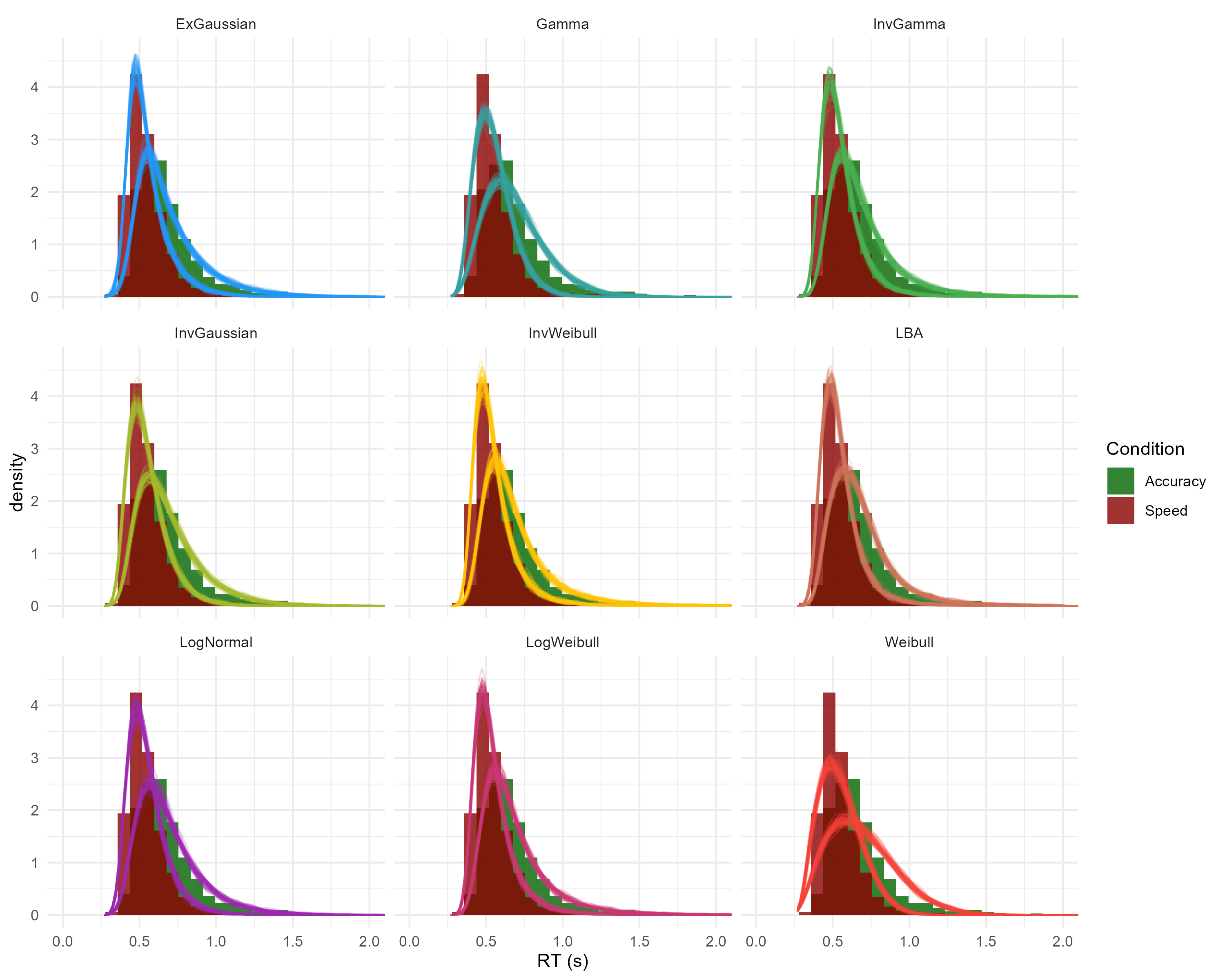
Models for Reaction Times
mu and sigma index the Gaussian component alone and tau the exponential tail - unlike brms’s native exgaussian() mu indexes the mean of the entire distribution)Schwarz, 2001 )Birnbaum & Saunders, 1969 ) - evidence accumulating in discrete cycles, one-directionally; an equal mixture of a Wald and its length-biased twin, in the same drift and threshold parameters
Models for Decision Making (Choice + RT)
Models for Subjective Ratings Data (Likert/Slider Scales)
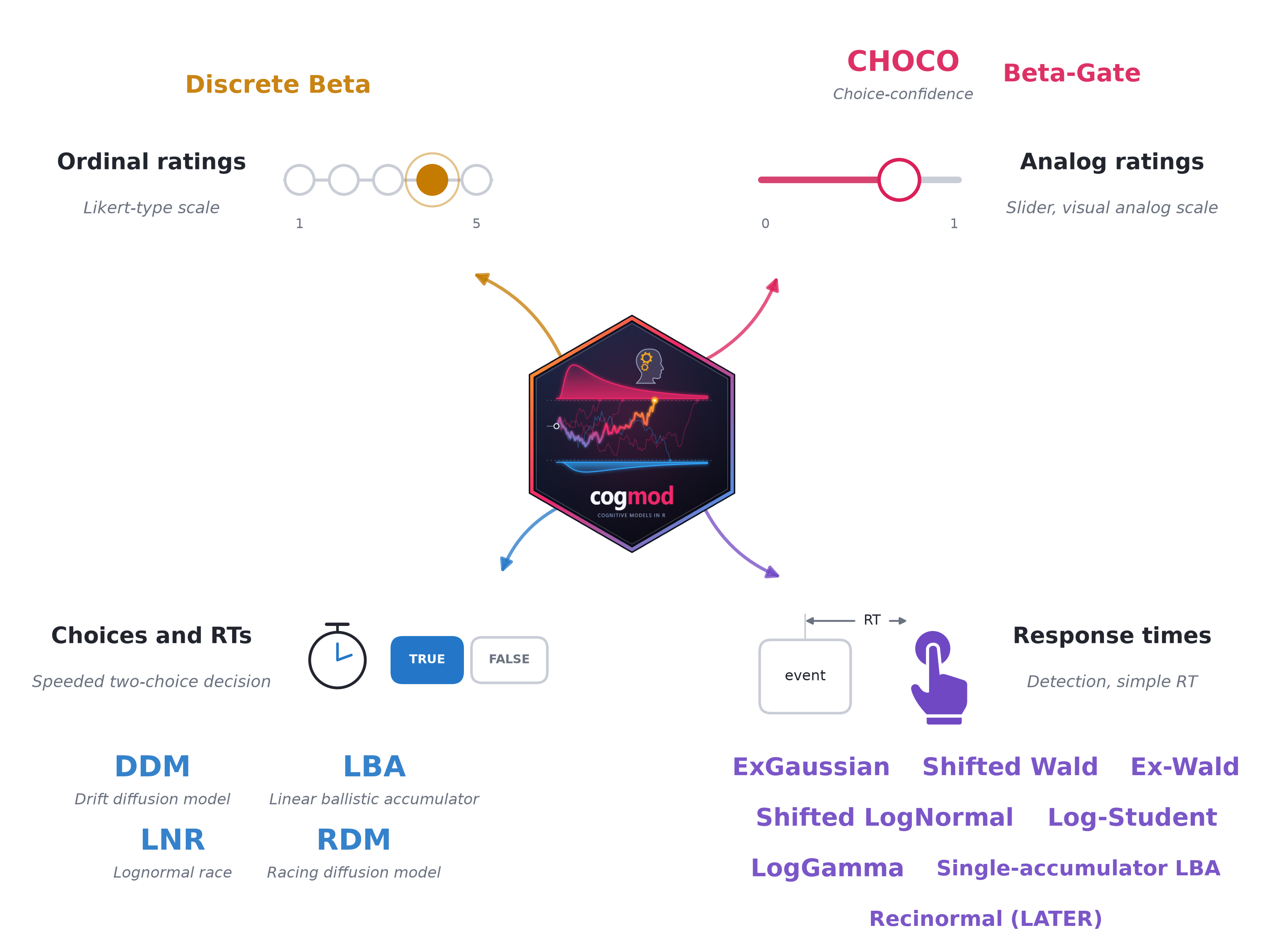
Response formats covered by cogmod, and the main families available for each. Every family comes with a _stanvars() function supplying its Stan code, and with d*() and r*() functions for density evaluation and simulation.
What are Computational Cognitive Models?
Measures from cognitive tasks, such as decision-making paradigms involving fast responses or ratings, often produce noisy, specific, and complex patterns of results. Broadly speaking, there are three ways of analysing such data.
The Summary Statistics Approach : The traditional approach often involves not bothering with any of the distinctive characteristics of cognitive data, assume that observations are Normally distributed, and summarise them using simple statistics such as means (which is what linear models do). This is the approach underlying most t -tests, ANOVAs, and linear regression models. Although often convenient, these methods may provide a poor description of the data and offer only limited insight into the cognitive processes that generated the observations.
The Distributional Approach : A more principled approach is to choose statistical models that better account for these particular distributions. This can involve transforming the data (for example, log-transforming reaction times so that linear models are more justified), using robust statistical methods (resilient to non-normality), or adopting more appropriate probability distributions (e.g., using Ex-Gaussian models for RTs). While these approaches often improve model fit and statistical inference, there can be a gap between the descriptive distributional parameters estimated and the cognitive mechanisms underlying the data generation process.
The Computational Approach : The most recent approach is to use models that are specifically designed to approximate or account for the cognitive processes at stake. For instance, Evidence Accumulation Models conceptualize response time as the outcome of a noisy process of evidence accumulation in the brain. And Choice-Confidence models explain the bi-modal distributions often found with slider scales as the combination of a dual-process of discrete choice and continuous evaluation. These models combine a good distributional fit to the data with more meaningful and cognitively interpretable parameters.
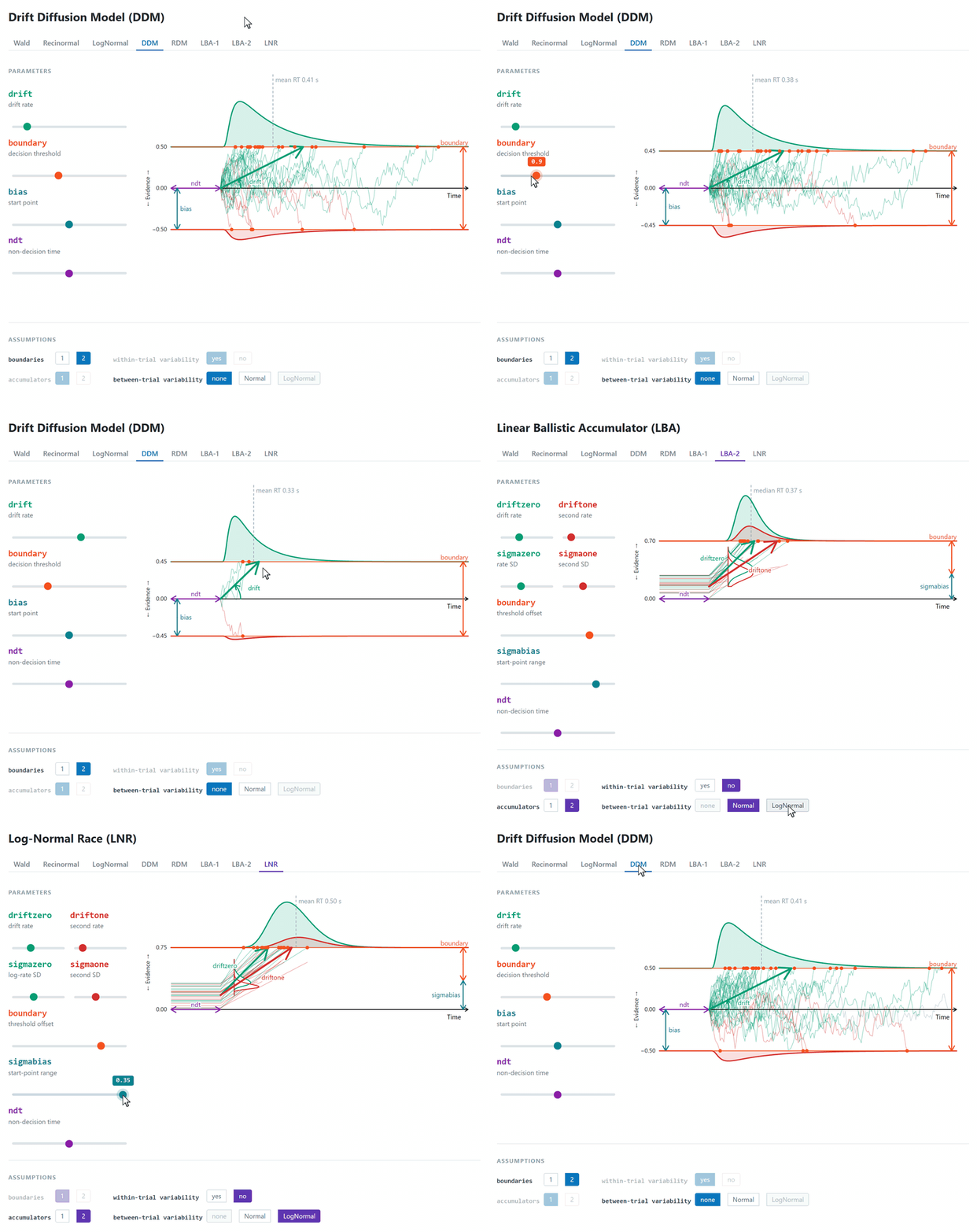
Illustration animation of Drift Diffusion Models
Installation
Install the released version from CRAN :
Or the development version from GitHub:
Fitting the models requires a working Stan installation through brmscmdstanr backend, which is not on CRAN: follow its installation guide to set up CmdStan.
Usage
Using a cogmod model requires two arguments beyond a standard brm() family and stanvars. Two further helpers, cogmod_priors() cogmod_inits()
library ( cogmod ) library ( brms ) # Specify the formula using brms' bf() f <- bf ( RT ~ Condition ,
sigma ~ Condition ,
ndt ~ Condition ,
sigmabias = 0 , # No start-point variability
family = cogmod_lognormal ( )
) # Fit the model m <- brm ( f ,
data = df ,
prior = cogmod_priors ( f , df ) ,
init = cogmod_inits ( f , df ) ,
stanvars = cogmod_stanvars ( f ) ,
backend = "cmdstanr"
) We can then analyze its results, and check its predictions like with any other models. See the Subjective Ratings , RT-only Models , and Decision Making Models vignettes for more detailed examples.
Roadmap
Log-logistic - log(RT - ndt) ~ Logistic. The motivation is the hazard function : Weibull and Gamma hazards are monotone, whereas the log-logistic rises then falls, a shape none of the current families can produce.Early responses as a process rather than a fixed mixture. poutlier currently mixes in a half-Normal at zero with a fixed scale: a contaminant with no mechanism, there so that one stray fast response cannot drag ndt down. LATER handles the same responses with a second accumulator - an “early” or “maverick” unit with a mean rate near zero and a large SD - that races the main one, so an early response is a decision that happened to win rather than a trial the model disowns. That is the better account, and it is what the second line on a reciprobit plot actually is. It is also a large undertaking: a race needs the winner’s density against the loser’s survival for every family in .OUTLIER_FAMILIES, where the present mixture needs one scalar, and the early unit is deliberately half-defective (with a mean rate of zero, half its trials never arrive at all) - which our normalised densities cannot represent unless the race is there to absorb the missing mass. Put on hold until we find a design that does not cost every family its closed form.Shifted sinh-arcsinh (log-SHASH) (Jones & Pewsey, 2009 ) - location, scale, skewness and tail weight as four separate parameters. Where cogmod_loggamma() shape, SHASH decouples them.cogmod_priors() cogmod_inits() https://ampl-psych.github.io/EMC2/reference/DDMGNG.html
LBA with other drift-rate distributions (Terry et al., 2015 ).
LogNormal variant is done: it is cogmod_lognormal() cogmod_lnr() sigmabias > 0, since the shifted LogNormal and the LNR are that LBA with the start point removed, and adding the start-point range back was one dpar on each rather than new families. Two lessons from it carry over. The scaling constraint moves with the drift distribution - fixing the drift scale (sigmazero = 1, the LBA convention) pins the Normal and the Gamma, but a LogNormal rate’s sigma is untouched by rescaling, so the threshold has to be pinned instead, which is why the LNR’s offset is fixed at 1 - and Stan’s upper-tail normal log-CDF is not accurate enough for the fast tail (use erfc).Gamma and Fréchet drifts as families of their own, since there is no existing race to nest them into. Gamma variance grows with the mean, matching neural firing-rate variability and the recurring finding that the matching accumulator needs the larger drift SD (and it won the one published head-to-head, on lexical decision); its density is two regularised incomplete gammas per accumulator, and the cost is Stan’s gradient with respect to the shape, which is a slow series. Fréchet with sigmabias = 0 yields Luce / multinomial-logit choice probabilities, bridging RT models and random-utility choice models, but its heavy drift tail produces too many very fast responses and its mean is undefined for shape ≤ 1. The four predicted CDFs are nearly indistinguishable and differ only in the tails, so the drift distribution is a modelling choice to justify theoretically and to compare by LOO or Bayes factor, not by raw likelihood. Validate against rtdists::dLBA() sigmabias = 0 limits reduce to the named distributions (inverse-Gamma and Weibull), and run a cross-fitting matrix at realistic per-participant trial counts (the published comparison used 20,000).
Curvilinear LBA trajectories. Any trajectory that is affine in the start point z and the drift v - x(t) = a(t) z + g(t) v + c(t) - crosses the threshold exactly when the plain LBA does with an effective time g(t), an effective start-point range a(t) * sigmabias and an effective threshold b - c(t), so its CDF is one wrapper around the LBA core (density by the chain rule) and it inherits every drift distribution above for free. Three choices of (a, g, c) are worth having, in this order. Time warp (x = z + v g(t), e.g. g(t) = (exp(gamma t) - 1) / gamma, series-expanded near gamma = 0): a time-dependent gain on evidence, the ballistic counterpart of urgency signals (Hawkins et al., 2015 ); it preserves the finishing-time order on every trial, so choice probabilities are exactly the LBA’s and only the RT shape changes - a built-in unit test. A collapsing threshold is the additive cousin (c(t) = b - b(t)) and does move accuracy. Ballistic Ornstein-Uhlenbeck (dx/dt = v + gamma x, so a = exp(gamma t)): the Leaky Competing Accumulator (Usher & McClelland, 2001 ) without noise or inhibition; gamma < 0 is leak, gamma > 0 self-excitation (Bogacz et al., 2006 ). The start point is amplified or forgotten over time, an accumulator finishes only if z + v / gamma > 0, so bias and drift interact and accuracy changes; and with piecewise-constant input the integral stays analytic, giving primacy (gamma > 0) or recency (gamma < 0) - the LCA’s signature phenomenon with a closed-form likelihood. Accumulator-specific gamma is cheap; ballistic lateral inhibition keeps affinity but makes the winner’s density a bivariate integral over the start-point box; a floor at zero breaks affinity and is out of scope. Literal gravity (dx/dt = v + gamma / (b - x)^2) is not affine in v, needs a one-dimensional quadrature and loses the composability, so only if a story specifically needs distance-dependent attraction. Expect gamma to trade off against threshold and drift scale, since curvature acts on the tail exactly where the drift distributions differ; recover before believing anything.Expected-RT attractor (a prior over decision time). Hypothesis: given a goal the system holds a prior T* on how long the decision should take, and trajectories heading to finish early are slowed while late ones are sped up, so the attractor is the point (T*, b) on the threshold rather than the threshold line - bidirectional bending that gravity cannot produce. In the linear-Gaussian case predictive coding is precision weighting, so the effective rate is the sensory drift shrunk toward the rate that reaches threshold at T*: v_eff = (1 - w) v + w v*, with w the relative prior precision. Two readings of v* map onto the two mechanisms above: a prior over finishing time , v* = (b - z) / T*, is a pure time warp with g(t) = (1 - w) t / (1 - w t / T*) and leaves accuracy untouched; a prior over rate , v* = b / T*, is an LBA with drift scaled by (1 - w) and a linearly collapsing threshold b (1 - w t / T*), and moves accuracy. Both are affine, so both are wrappers on the same core; curvature proper appears when w(t) evolves (rising as T* approaches, or falling as sensory precision accumulates), still affine, still closed form. The distinctive prediction is that urgency and collapsing bounds compress only the right tail, whereas a time prior pulls the fastest responses toward T* too - so manipulate temporal expectation (pacing, deadline, foreperiod) and test whether the 10th percentile moves, not only the 90th. Known problems: nothing finishes after T* / w because the prior eventually dominates (bound w(t) below 1, or give T* trial-to-trial variability at the cost of one quadrature, as scalar timing would suggest anyway); and T* is a new time scale competing with boundary, sigmabias and drift scale, identified only through RT shape in the first version. Precedents: Frazier & Yu (2008) and Drugowitsch et al. (2012) let a prior over time act on the threshold ; Simen et al. (2011) model interval timing as an accumulator whose drift is set to b / T*. This is a precision-weighted blend of Simen’s timing ramp with the LBA’s evidence ramp. Order: the finishing-time version first (a specific g(t), nearly free once the time warp exists), then the rate version, then w(t), then T* variability if the hard ceiling bites. Unit tests: w = 0 recovers the LBA, the first version reproduces LBA choice probabilities exactly, the second with fixed w reproduces the collapsing-threshold LBA.https://doi.org/10.1007/s11336-023-09902-z ; https://arxiv.org/abs/2604.26055 ; https://osf.io/preprints/psyarxiv/mhj6v ; https://osf.io/preprints/psyarxiv/5c8w2_v1 https://link.springer.com/article/10.3758/s13428-025-02822-z